7 – Resource Management, Values, and Protocols
LDMLFN Approach to Resource Management
- Resource management is important for the survival and success of future generations.
- We must consider the effects that every action has on the next 7 generations.
- Water (nibi) is life. Water is considered sacred and regarded as a living entity. All life is born from water.
- Lac des Mille Lacs First Nation (LDMLFN) does not approve of any herbicide use in vegetation management except for the control of certain invasive species. LDMLFN is committed to its goal to reduce herbicide applications in our Traditional Territory. LDMLFN is working towards developing an alternative option for vegetation management that does not include the use of herbicides.
- LDMLFN is working on alternative solutions to long term vegetation management including using the right of way to plant and seed low growing species that will out compete tree species to reduce the “need” for herbicides.
- Appropriate vegetation management can create habitat for bees and butterflies while also providing opportunities to grow medicinal and food plants.
- The goal of LDMLFN is to ensure resources exist for future generations and that those resources are both healthy and abundant.

What are Values?
- Values may differ between communities and Nations.
- Lac des Mille Lacs First Nation Values are the aspects of importance to the community in terms of life, culture, tradition, relation, and landscape.
- There are both abiotic or biotic values
- Values are key components of interest that serve as indicators of a holistic environment defined by the First Nation.
LDMLFN Values
- Wildlife habitat
- Food plants
- Berries
- Medicinal plants
- Sacred areas
- Burial sites
- Cultural heritage sites
- Spawning sites
- Species populations and diversity
- Ecosystem health
- Water
- Fishing and spawning areas
- Trapping areas
- Hunting areas
Values Recognition and Protocols
There are various sites across the Traditional Territory of LDMLFN that have uncertainty as to their exact locations. These sites include burials, ceremonial areas, cultural heritage sites, and abandoned areas. Oftentimes, when something is found, it is a place that family members have been searching for but can’t remember exactly where the site is.
It is important to remember that many people were forced to leave their homes due to schooling, 60s scoop, or by authorities due to the laws at the time. It is also important to remember that LDMLFN experienced widespread flooding, which forced families off reserve. It is therefore very important that appropriate consultation take place if anything is found during exploration or construction.
Anyone doing construction or exploration should be made aware of what to look for in terms of potential values that may need protection from development. There should also be awareness of proper protocols and steps to take when something is found. Communication about any findings is a very important part of reconciliation as well as consultations.
A teaching followed by many LDMLFN families is not to disturb items, remains of items, or to enter into certain areas that were left behind by those who have passed on.
Certain cultural items are considered sacred and are believed to have spirit attached to them. These items are not considered owned by a person, only held by a person.
Sacred items are cared for in very specific ways that are unique to each item. Additionally, places can also be considered sacred.
A cultural practice that is common amongst LDMLFN members has been to place sacred items in the bush, returning them to the earth (manitou aki) once the item either breaks or the person who has held the item(s) has passed away. To disturb such an item or a place is believed to disturb the associated spirit(s).

Recognizing Sites of Special Importance
- Piles of rock
- Circular clearings (they would be overgrown but it would look different from the surrounding forest).
- Ties of cloth on trees (branches or trunks)
- Remnants of buildings or cabins
- Old trees that have anything suspended in them (suspension burial)
- Mounds – any kind
- Graves – any indication of such as:
- a grave shaped depression in the earth
- crosses
- small house like structures
- marking on rocks
- stakes
- upside down sticks or trees
- upside-down stumps (symbolizes passing on to the spirit world)
- Bones
- cloth (trade cloth especially) Items that indicate an old site even though a building may not be visible (such as old stoves, old cans, ect)
- Old fire pits (may indicate a sacred area, settlement area, travel route, or give indication of something nearby)
- Old Items (sacred items were sometimes placed or hidden in the bush such as drums, or regalia for example) Remnants of wigwams or dome shaped structures.
- Pictographs
- Old traps or old tools
- Artifacts
- Posts/poles
- Circular structures
When items or sites are found, work must stop in the area and the First Nation must be contacted.
Cultural Heritage Sites
- Cultural heritage sites are more than just history. They are a part of a community’s memories and cultural connections in relation to the land.
- Cultural Heritage sites have been destroyed in the past by industry, government regulation, and expropriation of land. It is important to preserve what is left so that sites can be documented, and the information preserved for future generations.
- Cultural heritage landscape knowledge is at risk of being lost.
- Cultural Heritage sites can be high, medium, or low sensitivity.
- The First Nation whom the cultural heritage site is affiliated with, determines the level of sensitivity and protection that a site needs.
- The level of the sensitivity of a cultural heritage site determines the mitigation strategy.
- The images above are the remains of houses. The site where these homes once stood is a historical First Nation settlement area that was used since pre-colonial times. There are other values nearby including burials and ceremonial areas.
- There are certain areas along the Wassigan preferred route where there is a high likelihood that cultural heritage sites will be found. It is imperative that the First Nation is contacted when these sites are found by anyone working in the area as locating them is an important part of documenting the First Nation’s history.
- Any failure to report a cultural heritage site or potential cultural heritage site is in conflict with the LDMLFN Land Access Agreement. Sites such as these can vary in sensitivity, which will determine the appropriate mitigation as needed.
- It is important to remember that the people of LDMLFN were flooded out and displaced after the creation of dams for various reasons including hydroelectricity which caused widespread hardship on the community. Transparency is consequently a very important part of reconciliation especially in terms of the relationship between LDMLFN and Hydro One (which includes all those working under Hydro One and its subcontractors).
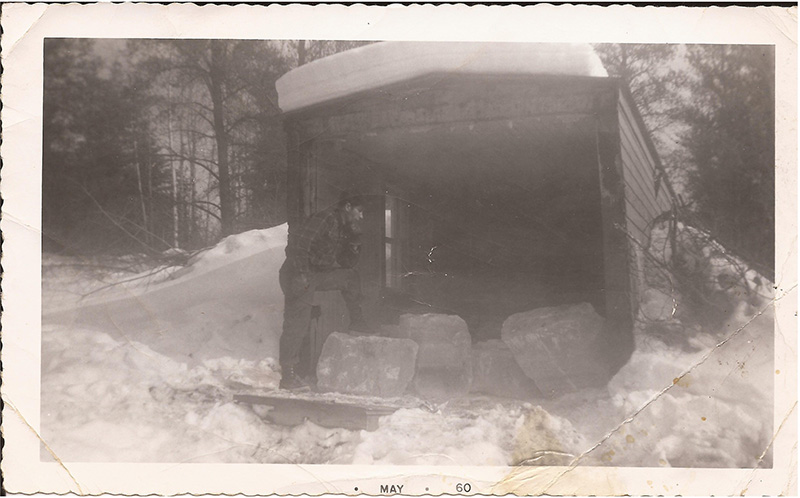
The image below, if found incidentally, may look like something left over from industry. In actuality, the former storage container was repurposed and used by a family as an ice storage house.
Archeological Sites
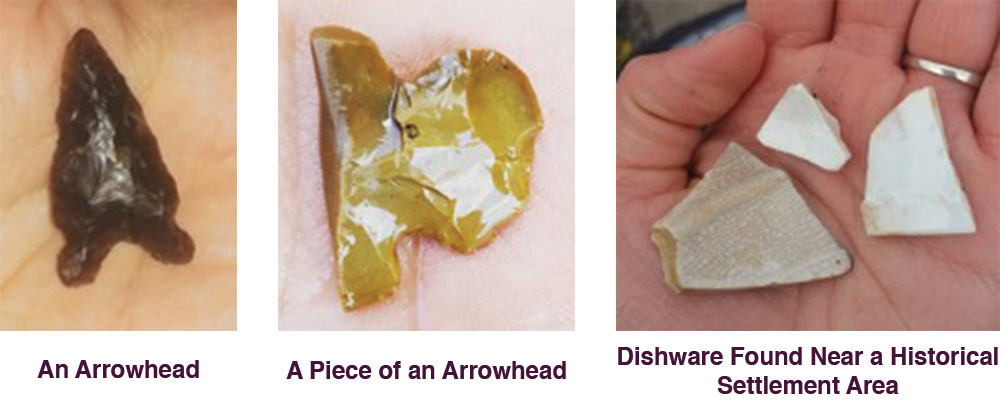
When archeological sites are found during construction or exploration on the Traditional Territory of Lac des Mille Lacs First Nation, the First Nation must be made aware of the discoveries so that appropriate consultation, documentation, and mitigation can occur. Archaeology work in northern Ontario is extremely lacking.
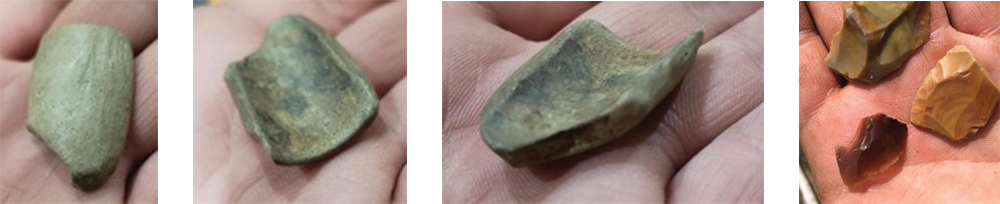
The images above are a piece of a pipe that was found on an archeological site known to Lac des Mille Lacs First Nation. The location of the site is kept confidential to protect the integrity of the site. The last image is of flakes, which are made during the process of creating stone tools and points. All images on this page are of items found by Lac des Mille Lacs members.
High Sensitivity Cultural Sites
- Burials
- Ceremonial areas
- Mounds and effigies
- Certain cultural heritage sites
- Sacred items that were placed in the bush
- Archaeological areas
A large circular ring with an opening constructed of medium and large stones found along an old river shoreline is an example of a high sensitivity cultural site. A site such as the one below, would be a site that should not be disturbed. Alternative planning to avoid the site would be needed. There is a possibility some sites may be uncovered during construction. Often, sites such as this one were built on shorelines (keep in mind shorelines move over time) or on the tops of hills.
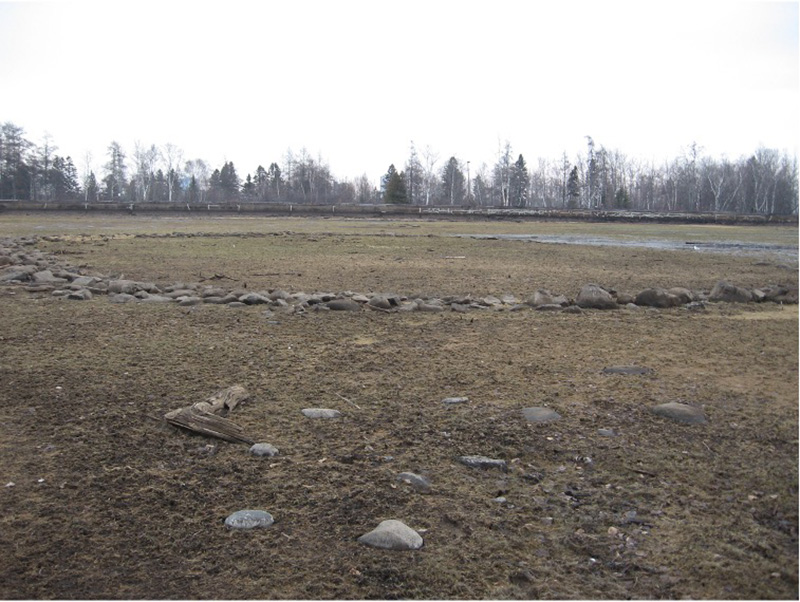
The site shown in the picture is easily recognized due to the lack of vegetation. It is uncommon to find a site that looks like this one as this site was exposed while water levels were below normal. Other similar sites exist but their exact locations are either confidential or undetermined.
Most sites that have a similar appearance are hard to recognize because they are overgrown by brush, plants, and moss and are often partially buried. It is very important to take the time to explore sites prior to construction by taking a walk and doing a visual inspection prior to construction.
Wildlife and Land Values Sensitivity
- It is difficult to assign the level of protection a species requires, as the viewpoint of the First Nation is that all species share equal importance. However, some species and land values may not require the same level of mitigation as others (depending on the type of disturbance and species) in order to achieve the same result or level of protection.
- Certain medicinal plants
- Moose travel corridors
- Moose aquatic feeding areas
- Certain food plants
- Wild rice
- Species at risk – every species is important
- Turtle crossing and laying areas
- Spawning areas
- Nesting sites
- Certain medicinal plants
- All water
Respecting Turtle Crossings and Egg Laying Areas
- The number 1 cause of population decline amongst turtles is death by motor vehicles, which occurs during egg laying season every year.
- Snapping Turtles lay eggs around the second and third week of June in northwestern Ontario.
- Painted turtles lay eggs around the third week of June in northwestern Ontario.
- Crews should call out the kilometer marker when a turtle is spotted on the road, so that other crews are aware and on the lookout for turtles in the area.
- Turtles should be moved off the road in the direction they are travelling.
- Do not crush or disturb nesting turtles under any circumstances.
- Night travel should be avoided, and speed limits reduced during turtle nesting season.
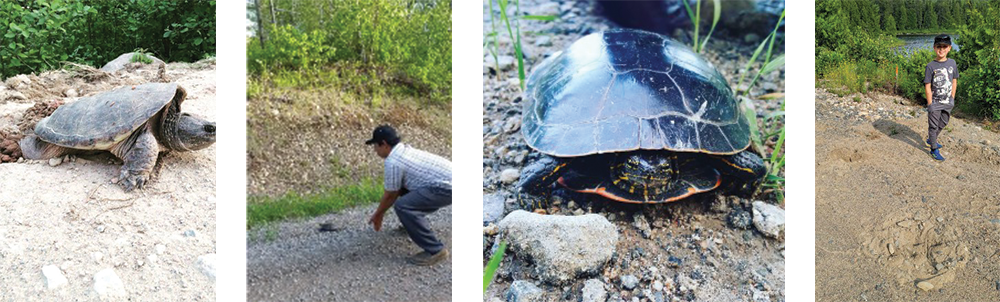
- Turtles look like rocks on the side or middle of roadways.
- Turtles take approximately 20 years to reach sexual maturity in northwestern Ontario.
- Due to a high amount of predation only 10% of turtle eggs survive. Every turtle hit on the road is a significant loss to the population in an area.
- It may be necessary to close certain sections of road during egg laying season or to fence off areas where eggs have been layed, so that eggs do not get crushed by vehicles after the turtles have finished using the area. Fencing off areas where eggs have been layed (while ensuring connectivity to the adjacent waterbody) would be an effective mitigation measure to help offset population loss to road mortality.
Please follow the link below to learn how to help a snapping turtle cross the road:
Proper Handling Methods
- It is best to first try and shoo a turtle off the road (as shown below) however, this may not always be an option.
- Always move a turtle off the road in the direction it was travelling.
- To move a painted turtle, or small snapping turtle, approach it from behind and pick it up, placing one hand under the shell, and one on top. You can also pick up painted turtles by placing your hands on the sides of the shell, avoiding the head.
- Never pick a turtle up by its tail or limb, as this can cause vertebrae and bones to break.
- If the turtle is too large to move, halt traffic, and shoo the turtle off the road in the direction it is travelling.
- If a large snapping turtle needs to be moved off a busy road, and shooing is not working, grab a large strong stick and have the turtle grab onto it. Then, slowly pull the turtle off the road by pulling the stick. Do not lift a turtle off the ground using this method as they can let go of the stick, fall, and be injured.
- Use caution around snapping turtles. Snapping turtles have strong, fast bites, and long necks.
Recognizing Turtle Nesting Areas
Turtles nest near water on sand or in gravel and often cross at these locations as well. Slowing down and avoiding night driving during turtle laying season will help reduce road mortality and nest destruction.
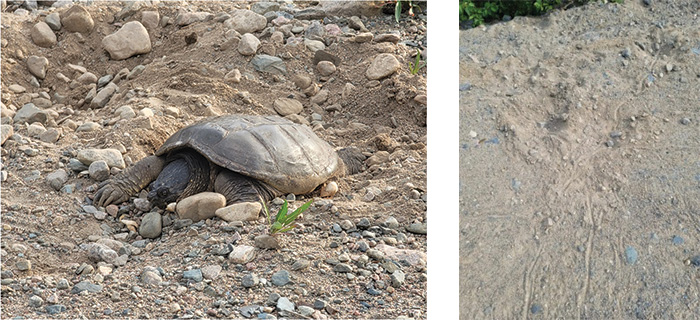
A turtle nesting area where turtles have buried eggs near the side of the road. Turtle tracks can also be seen.